How to Get Better at Sudoku: 9 Tips That Build Real Solving Skill
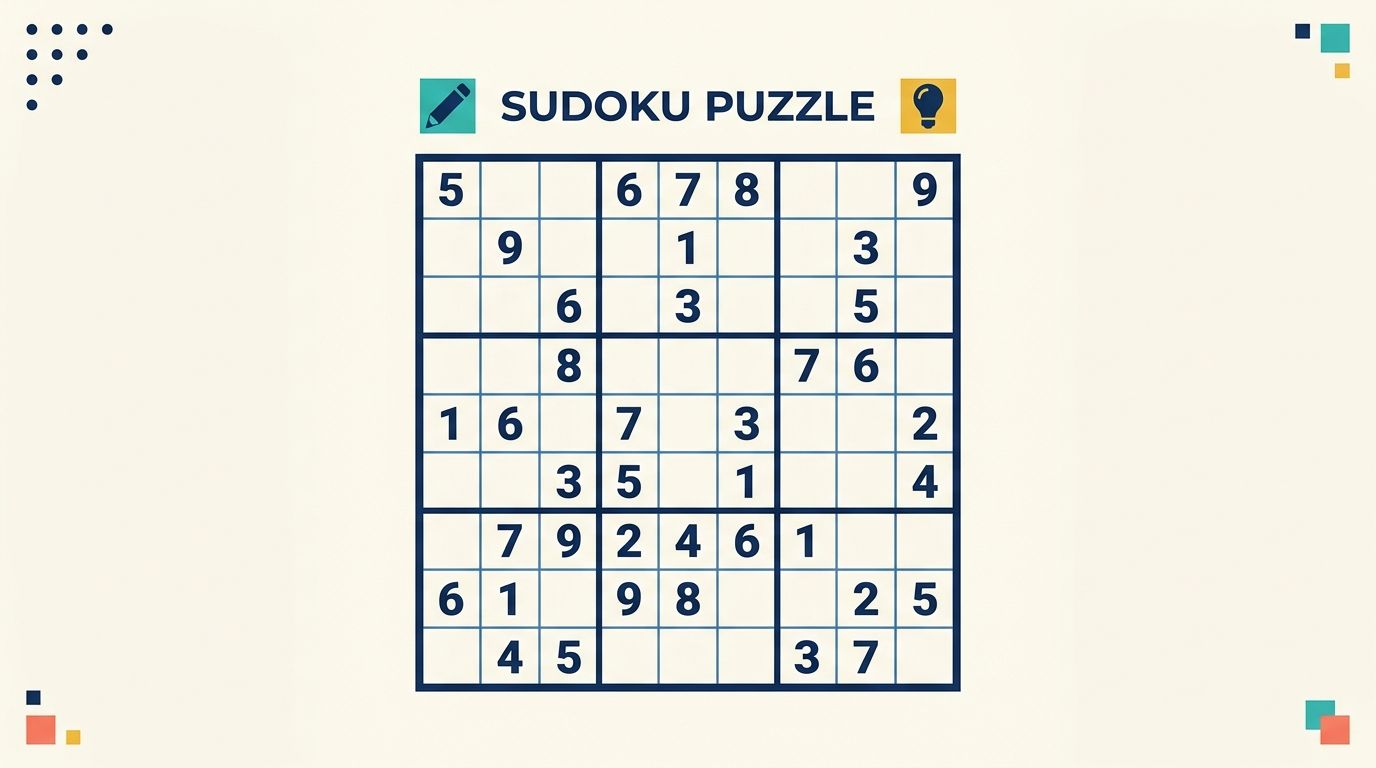
Getting better at Sudoku is not about staring harder or calculating faster. It is about learning where to look, recording what you know, and choosing moves that create useful new information.
The same habits work across Mini Sudoku, Medium Sudoku, and the classic 9 by 9 grid. A smaller board lets you see the logic with less bookkeeping; a larger one asks you to apply that logic more patiently.
These nine Sudoku tips are arranged in the order they become useful. Start with the first three on every puzzle. Add the later techniques when the obvious placements run out.
First, see the board as three overlapping maps
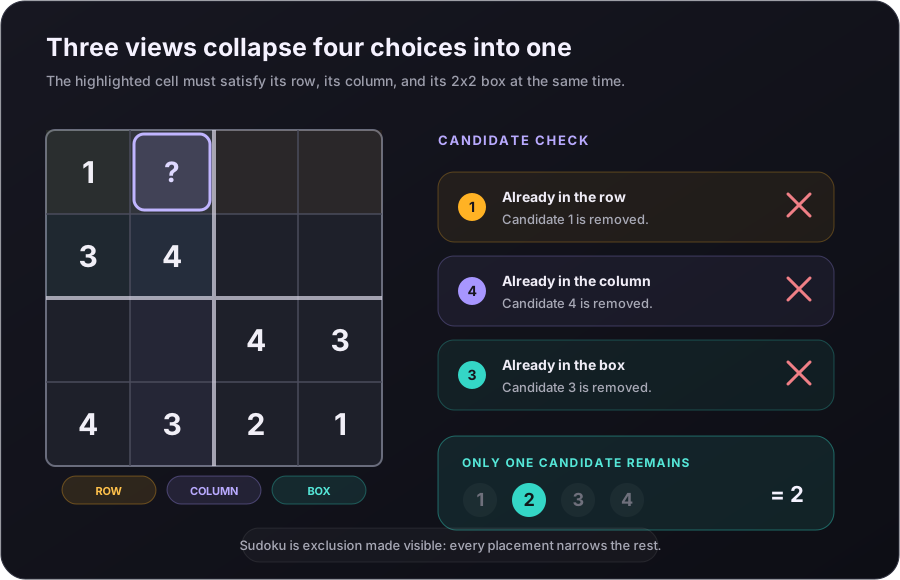
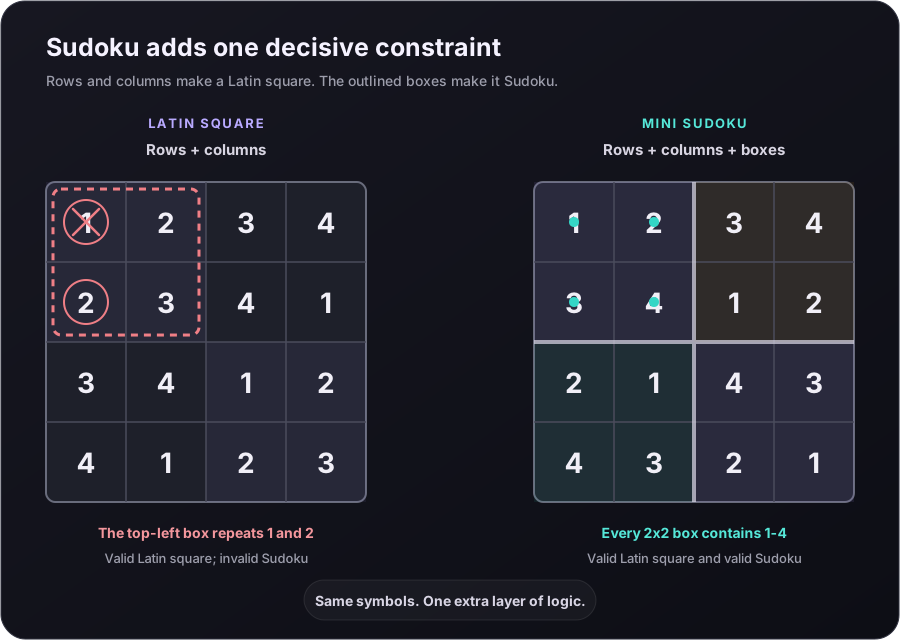
Every empty cell belongs to three units at once:
- one row;
- one column;
- and one outlined box.
A number can appear only once in each unit. That is the entire rule, but the overlap is what makes the puzzle work. A cell that looks ambiguous from its row may become certain when you also check its column and box.
Sudoku uses digits as labels, not quantities. You never need to add them. You only need to ask two questions:
- Which numbers can go in this cell?
- Where can this number go in this unit?
The first question finds a naked single: a cell with one candidate. The second finds a hidden single: a number with one legal home in a row, column, or box. Most progress comes from switching deliberately between those two views.
Tip 1: Scan for the number, not just the empty cell
Beginners often inspect empty cells one by one. That works, but it can hide an easier pattern. Try choosing one number and tracing it across the whole board instead.
Suppose you are looking for every missing 6. Find a box without a 6, then use the existing 6s in nearby rows and columns to eliminate spaces inside that box. If all but one position is blocked, the remaining cell must be 6.
This technique is sometimes called cross-hatching. It is especially effective early in a puzzle, when the givens create long, visible lines of exclusion.
A simple scanning rhythm is:
| Pass | What to inspect | What you are looking for |
|---|---|---|
| 1 | Each number in turn | A box with only one legal position |
| 2 | Nearly complete rows | A missing number with one legal cell |
| 3 | Nearly complete columns | A missing number with one legal cell |
| 4 | Nearly complete boxes | A missing number with one legal cell |
Do not expect every pass to produce a placement. The purpose of a repeatable scan is to prevent you from overlooking the simplest move.
Tip 2: Start where the board is crowded
A row with seven filled cells is usually more informative than a row with three. The same is true for columns and boxes.
When deciding where to focus, look for the unit with the fewest blanks. List its missing numbers, then test those numbers against the crossing units. If a row is missing 2 and 8, for example, a 2 already present in one blank’s column immediately settles both cells.
This is not a rule that the most crowded area will always solve first. It is a way to spend your attention where the constraints are strongest.
On a small board, you can often hold the missing set in your head. On a 9 by 9 puzzle, write it down. Externalizing candidates is not a crutch; it frees your working memory to notice relationships.
Tip 3: Pencil in candidates consistently
Candidate notes are useful only when they are trustworthy. If you write candidates in some cells but ignore others, the pattern you need may remain invisible.
For each unsolved cell, remove numbers already used in its row, column, and box. Record what remains. Then update nearby notes whenever you place a number.
Use candidates when scanning stops producing immediate answers. Adding every candidate at the very beginning can create visual noise, while refusing to add them at all makes intermediate puzzles needlessly hard.
A good rule of thumb is:
- scan first;
- add candidates to the most constrained area;
- expand the notes only if the puzzle still resists;
- erase candidates immediately after a placement affects them.
Clean notes turn the grid into a map of possibilities. Stale notes turn it into misinformation.
Tip 4: Alternate between cells and units
If you repeatedly ask only “what fits here?”, you will find naked singles but miss hidden singles. If you ask only “where does this number go?”, you can miss a cell whose three units jointly leave it one candidate.
Build a two-direction loop:
| View | Question | Typical result |
|---|---|---|
| Cell-first | Which candidates survive here? | Naked single |
| Unit-first | Where can this missing number go? | Hidden single |
After every placement, run both views through the affected row, column, and box. One solved cell changes three units, so it may create several follow-up moves.
That follow-up is where solving speed comes from. Strong solvers are not necessarily spotting isolated facts faster. They are better at following the consequences of each fact before moving their attention elsewhere.
Tip 5: Let boxes talk to rows and columns
Sometimes a number has two or three possible cells inside a box, so you cannot place it yet. But if all those candidates sit in the same row, that number is locked into that row within the box. It can be removed from the rest of the row outside the box.
The same logic works with a column. This pattern is known as a locked candidate, pointing pair, or pointing triple, depending on its shape.
Think of it as a promise:
The number must appear somewhere along this small section of the row, so it cannot appear anywhere else along the row.
The reverse pattern works too. If every candidate for a number in a row lies inside one box, that number can be removed from the other cells in the box.
You may not get an immediate placement. That is fine. Eliminating one candidate can expose a single somewhere else.
Tip 6: Look for pairs that reserve two cells
Suppose two cells in the same row contain exactly the candidates {3, 7}. You do not know which cell is 3 and which is 7, but you do know those two numbers must occupy those two cells. Therefore, 3 and 7 can be removed from every other cell in that row.
That is a naked pair. It also works in columns and boxes.
A hidden pair is the same reservation viewed from the opposite direction: two numbers appear as candidates in only the same two cells of a unit, even if those cells currently contain other notes. Those other candidates can be removed.
Pairs are powerful because certainty does not always mean knowing an exact value. Knowing that two values are confined to two spaces is already actionable information.
Tip 7: After every breakthrough, rescan locally
One of the easiest ways to make Sudoku feel harder is to place a number and then jump to an unrelated corner.
Instead, use a short consequence loop:
- Place the number.
- Remove it from candidates in the same row, column, and box.
- Check those three units for new naked or hidden singles.
- If another number is placed, repeat from that cell.
- Return to a full-board scan only when the chain ends.
This creates the satisfying cascades associated with well-made puzzles. A placement unlocks a box; the box completes a row; the row resolves another box.
If you ever wonder how an experienced solver finishes quickly, this habit explains much of the difference. They harvest the entire chain of consequences instead of repeatedly rediscovering it.
Tip 8: Treat a contradiction as feedback, not failure
If you discover a duplicate number, an empty cell with no candidates, or a unit with no legal home for a missing number, something earlier is wrong.
Do not patch the latest cell and continue. Rewind to the most recent uncertain move and restore the board to a valid state. On a digital board, use undo. On paper, keep speculative notes visually distinct from confirmed placements.
Better still, avoid guessing when a logical move is available. A guess branches the puzzle into alternate realities and doubles the bookkeeping. Before trying one candidate “just to see,” perform another systematic scan for:
- hidden singles;
- locked candidates;
- naked pairs;
- incomplete candidate notes;
- and recent placements whose consequences were not fully traced.
On a fair puzzle, that audit often reveals the missed step.
Tip 9: Practice one technique at a time
Solving more puzzles helps, but deliberate practice helps faster. After each game, identify the moment where you became stuck. What kind of information finally restarted the puzzle?
Try a focused practice ladder:
| Stage | Main goal | Move on when… |
|---|---|---|
| Mini Sudoku | See row-column-box overlap | Singles feel automatic |
| Easy 6 by 6 | Build a consistent scan | You rarely miss a hidden single |
| Medium 6 by 6 | Maintain candidates | Notes stay accurate through cascades |
| Easy 9 by 9 | Control attention across a larger grid | You can scan without wandering |
| Intermediate 9 by 9 | Recognize interactions | Locked candidates and pairs stand out |
When checking a completed puzzle, do more than note the time. Ask which technique produced the decisive move and whether your candidate notes made it easy or hard to see.
Speed is a side effect of recognition. The goal is not to rush each decision; it is to make common patterns familiar enough that they stop demanding effort.
A compact routine for any Sudoku
When you open a new board, follow this sequence:
- Scan each digit through the boxes.
- Inspect the fullest rows, columns, and boxes.
- Place all naked and hidden singles.
- Update the three units touched by every placement.
- Add complete candidates where progress has stalled.
- Search for locked candidates and pairs.
- Rescan for singles after every elimination.
- Audit the grid before making any speculative move.
The sequence matters because advanced patterns are built from accurate basic information. There is little value in hunting for a complicated formation while an unmarked single is waiting in the next row.
The real skill is attention
Sudoku rewards a particular kind of patience. You hold several possibilities without treating them as facts. You move between a detail and the whole board. You allow one small certainty to reshape everything around it.
That is why a 4 by 4 puzzle can teach the same core skill as a 9 by 9 one. The larger grid contains more candidates, but the central act never changes: combine the row, column, and box until possibility becomes necessity.
When you feel stuck, do not ask yourself to be clever. Ask a smaller, more useful question:
Which unit have I not examined from the other point of view?
Then scan again. The next move is often already on the board, waiting for the right question.