From Doublets to Daily Ladder: The History of the Word Ladder

A modern word ladder looks perfectly at home on a phone: short words, crisp rules, and the satisfying click of one letter changing at a time. Its origins, however, belong to Victorian drawing rooms, weekly magazines, handwritten entries, and a famously playful mathematician.
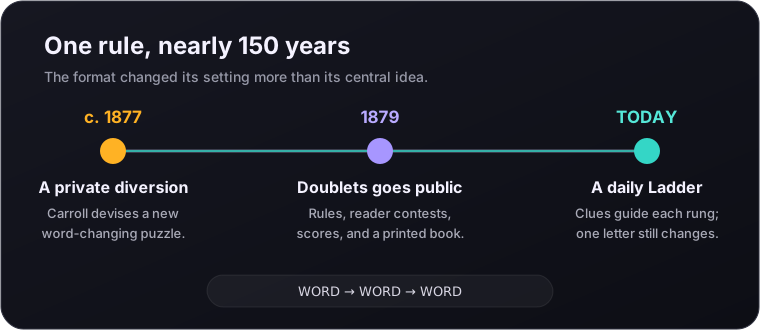
Lewis Carroll - the pen name of Charles Lutwidge Dodgson - introduced the puzzle to a wide audience in 1879 under the name Doublets. Nearly a century and a half later, the central rule remains wonderfully intact.
A cure for having nothing to do
Carroll explained the origin story in the preface he sent to the British magazine Vanity Fair. He recalled that, a little more than a year earlier, two young women had asked him for riddles because they had “nothing to do.” Having no riddles ready, he devised a different kind of verbal challenge.
That account places the private beginning of the game around Christmas 1877. Early versions were also known as Word-Links, but the name attached to the published puzzle was Doublets.
The first Vanity Fair installment appeared on March 29, 1879. Later that year, Macmillan and Co. published Doublets: A Word-Puzzle, preserving the rules, examples, glossary, competitions, and solutions in book form.
This was not merely a list of puzzles. Carroll gave the format a vocabulary:
- The two words at the ends were a Doublet.
- Each word inserted between them was a Link.
- The complete sequence was a Chain.
Those names make the puzzle sound almost chemical, as if one word is being transmuted into another. That was exactly the joke behind many of Carroll’s prompts: turn APE into MAN, make WHEAT into BREAD, change TEARS into SMILE, or prove BLACK to be WHITE.
The original rule is still the rule
Carroll’s published instructions begin with two words of equal length. The solver inserts real words between them, changing exactly one letter at each step. Letters cannot trade places; the new letter must occupy the same position as the old one.
His demonstration transformed HEAD into TAIL:
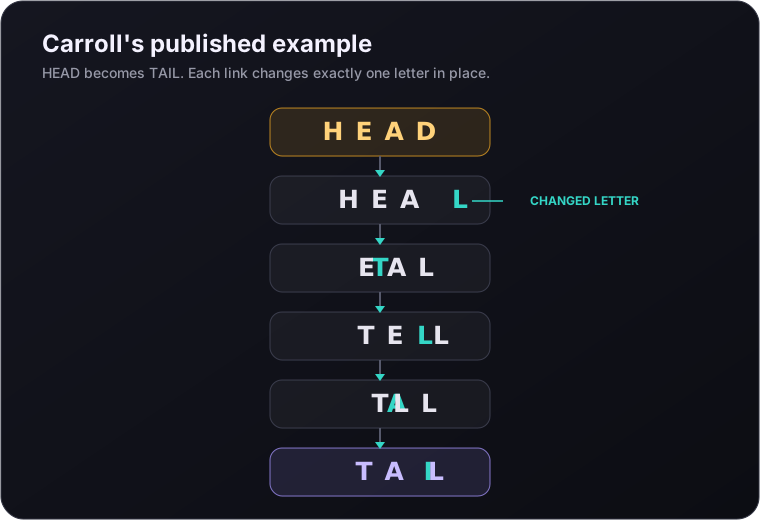
Read downward and the mechanism is immediately visible:
HEAD -> HEAL -> TEAL -> TELL -> TALL -> TAIL
Every move changes one position. Every intermediate arrangement is an English word. The sequence also shows why the format is richer than a spelling exercise. Changing the obvious letter is easy; finding a change that leaves useful exits for the next move is the real work.
Doublets was a competitive daily-game ancestor
The presentation in Vanity Fair feels surprisingly current. Preliminary puzzles taught readers the rules. A competition followed. Results were published regularly, prizes were offered, and efficient solutions earned better scores.
Carroll’s objective was to complete a Chain with the fewest possible Links. For the HEAD-to-TAIL example, readers who matched the shortest accepted chain received full marks; extra Links cost points. The magazine therefore gave players several things familiar from modern puzzle culture:
- a shared challenge,
- a clear scoring system,
- comparison with other solvers,
- and a reason to return for the next installment.
The delivery system was print rather than pixels, and the feedback loop took days rather than seconds. The social structure of the game was already there.
The dictionary was part of the design problem
One-letter rules are precise, but the phrase “real word” is not. Competitors quickly found obscure, regional, archaic, or otherwise debatable Links. Carroll responded with a glossary of acceptable words from three to six letters.
The glossary reveals both practical puzzle construction and the assumptions of its era. Carroll wanted words that educated players could reasonably know without searching a dictionary. His standard was framed in the class-conscious language of words usable in “good Society,” a judgment modern editors would rightly avoid.
Yet the underlying editorial problem remains. A word ladder is only as fair as its word list. Include everything ever printed and the chain fills with baffling fragments. Restrict the list too aggressively and elegant routes disappear. Contemporary constructors still balance familiarity, variety, and connectivity; software can search a dictionary, but a human editor decides whether the result feels playable.
Under the surface, a ladder is a map
A useful modern way to understand the puzzle is as a network. Imagine every allowed four-letter word as a point. Connect two points whenever their words differ in exactly one position.
COLD connects to CORD, for example, because only the third letter changes. CORD connects to WORD because only the first letter changes. A classic Doublet asks you to find a route through this network from one endpoint to another. Asking for the fewest Links turns it into a shortest-path problem.
That mathematical view explains a familiar solving experience. Some words are busy junctions with many possible neighbors. Others are near dead ends. A move can be legal but strategically poor if it enters a sparse part of the word network.
Carroll did not need graph terminology to recognize this. His advice included paying attention to the pattern of vowels and consonants and first reshaping one endpoint so that it better resembled the other. In modern terms, he was looking for useful structure in the network before choosing a route.
How Puzzle Round’s Ladder changes the format
Puzzle Round Ladder keeps the one-letter Chain but changes what the player is given. A classic Doublet supplies the first and last words, then asks the solver to invent the middle. Puzzle Round supplies a clue for every rung. Solving one clue reveals letters that constrain its neighbors.
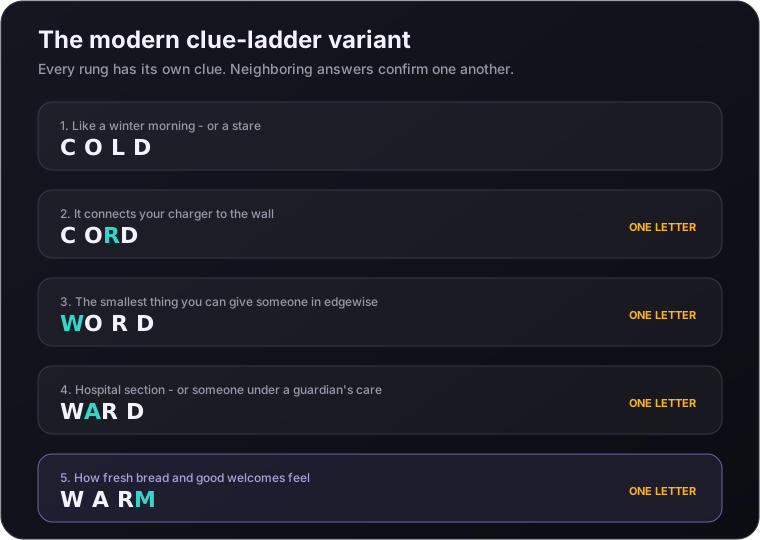
In the example above, the clue sequence resolves to:
COLD -> CORD -> WORD -> WARD -> WARM
The first clue can be solved on its own, but it also establishes a pattern for the second answer. Later, if the hospital clue suggests WARD, the neighboring words tell you that the answer must differ from each by one letter. Vocabulary and structure cross-check each other.
This variant shifts the goal from finding the shortest route to recovering the intended route. It is part word ladder and part compact crossword: each answer must satisfy both a definition and the geometry of the chain.
A practical way to climb
The best entry point is not always the first rung. Try this sequence:
- Scan every clue. Fill the most specific answer first, wherever it appears.
- Compare neighbors. Once one rung is known, mark which positions could plausibly change above and below it.
- Use both constraints. A candidate must fit its clue and differ from the adjacent answer by exactly one letter.
- Work from two directions. Solving separated rungs can squeeze the possibilities for the word between them.
- Question the clue sense. Short words often have several meanings; a clue may point to a verb, noun, adjective, or idiom.
- Check the entire Chain. A good answer in isolation can still be wrong if it breaks a neighboring transition.
The constraint that makes a ladder difficult is also what makes it fair. Each solved word gives you information about the next one.
Why the design lasted
Many nineteenth-century amusements survive mainly as curiosities. The word ladder still feels alive because its rule is compact enough to explain in one sentence and generative enough to produce thousands of distinct puzzles.
It combines two kinds of pleasure. There is the local satisfaction of finding a word that fits, and the larger satisfaction of watching a transformation unfold. HEAD does not merely sit beside TAIL; one becomes the other through a visible sequence of valid states.
The medium has changed from a magazine column to a daily screen, and Puzzle Round adds clues, instant validation, timers, and shared results. But each successful rung still performs the same small piece of magic Carroll published in 1879: change one letter, keep the word, and discover where the Chain can go next.