From Eight Queens to Crowns: How a Chessboard Problem Became a Daily Logic Puzzle

Place eight queens on a chessboard so that none can attack another. The sentence is short enough to remember after one reading. The search it opens has occupied chess players, mathematicians, and computer scientists for more than 175 years.
Puzzle Round Crowns is not simply the old problem with colored cells, and there is no documented straight line of invention connecting the two. But the games belong to the same remarkable design family: place one royal piece in every row and column, then use one more spatial rule to make the board yield.
The challenge in a German chess magazine
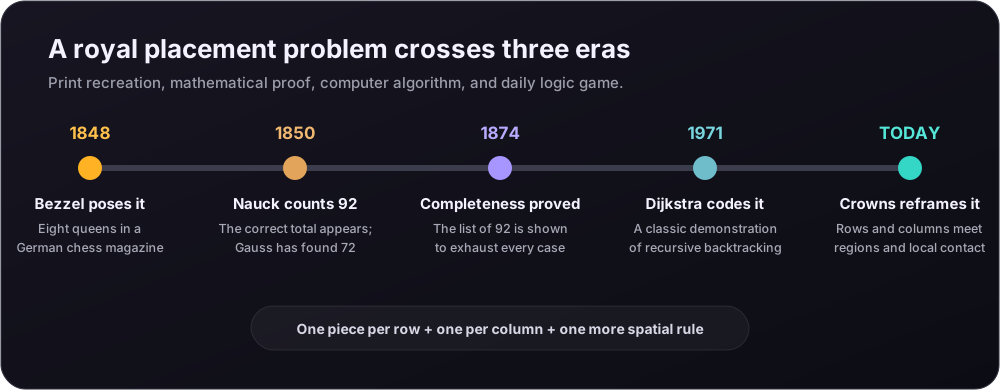
In September 1848, chess composer Max Bezzel published the problem in the Schachzeitung der Berliner Schachgesellschaft. He asked for eight queens to be arranged on an ordinary 8 by 8 board so that no queen could capture another.
A chess queen attacks along its row, column, and both diagonals. A valid arrangement therefore needs exactly one queen in every row and every column, with no two sharing a diagonal of any length.
The puzzle arrived at a fertile moment. Chess problems were a popular form of print recreation, while the grid made the challenge legible even to someone more interested in patterns than in playing a match. Bezzel had reduced the power of chess’s strongest piece to a pure placement question.
Nauck found 92; Gauss found 72
Two years later, Franz Nauck published solutions in the Illustrirte Zeitung of Leipzig. His final count was 92 arrangements. At roughly the same time, mathematician Carl Friedrich Gauss investigated the problem in correspondence with astronomer Heinrich Christian Schumacher.
Gauss initially found 76 arrangements, then discarded four duplicates and settled on 72 before learning of Nauck’s larger count. The episode is a useful warning: finding many solutions is not the same as proving that none are missing.
Nauck’s list did not itself prove completeness. That came in 1874, when work by J. W. L. Glaisher and C. F. de Jaenisch Pauls established that the 92 arrangements exhausted the possibilities. The history is unusually compact: the question appeared in 1848, its correct count appeared in 1850, and a proof followed a generation later.
Why 92 can also mean 12
The number depends on what counts as different. Rotate a solved board by 90 degrees and the queens still do not attack one another. Reflect it in a mirror and the result is still valid.
If every orientation is counted separately, the Eight Queens problem has 92 solutions. If arrangements related by rotation or reflection are grouped together, only 12 fundamental solutions remain. Eleven of those families produce eight orientations each. One especially symmetric family produces only four, because a half-turn returns it to the same arrangement.
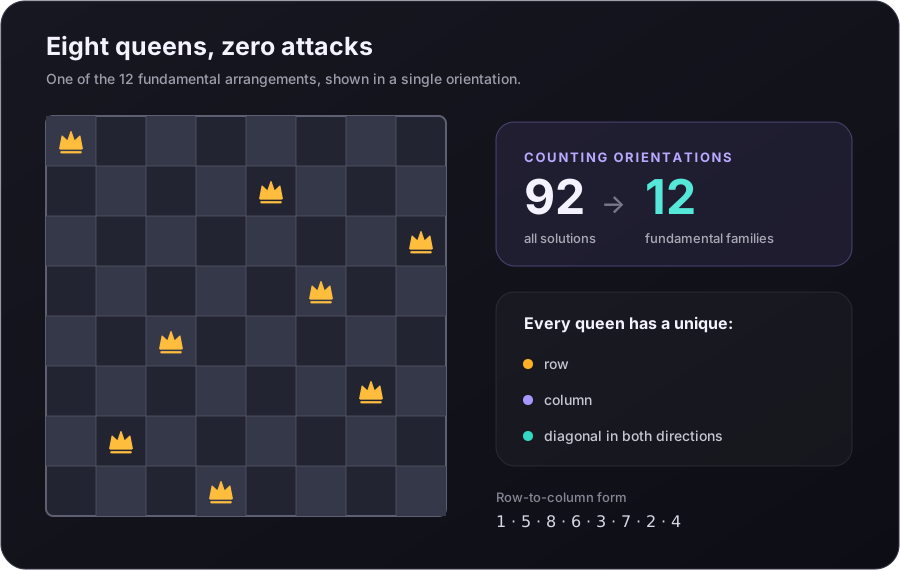
This is more than numerical trivia. Symmetry is one of the solver’s best tools. A first queen placed in the upper-left portion of the board can stand in for several mirrored or rotated cases. The physical board contains 64 squares, but the search does not need to treat all of them as unrelated.
A puzzle becomes an algorithm
The generalized version asks for n non-attacking queens on an n by n board. Once the size becomes a variable, the puzzle turns into a compact laboratory for computation.
A naive program might inspect every way to choose eight squares from 64. A better program builds a position one row at a time:
- Place a queen in a currently legal column.
- Move to the next row and repeat.
- If a row has no legal square, remove the previous queen.
- Try its next possible position.
That retreat is backtracking. The program abandons a partial arrangement as soon as it cannot lead to a full one, rather than wasting time filling a doomed board.
In 1971, computer scientist Edsger W. Dijkstra used Eight Queens in A Short Introduction to the Art of Programming to explain recursion and backtracking. He represented a position with one column number per row and kept separate records of which columns and diagonals were available. His final program generated all 92 configurations, but he emphasized that the reusable method mattered more than the answer.
That is why Eight Queens became a classroom classic. The rules are visual; the state is small; failure is easy to recognize; and the search tree is large enough to demonstrate why a systematic method beats blind enumeration.
What Crowns keeps - and what it changes
Puzzle Round Crowns inherits the most elegant part of the old structure:
- exactly one crown in every row,
- exactly one crown in every column,
- and a board where each placement removes possibilities elsewhere.
Then it changes the remaining constraint. In Eight Queens, pieces may not share any diagonal, even from opposite corners of the board. In Crowns, pieces may share a long diagonal; they simply may not touch, including at a corner. A crown rules out the eight neighboring cells, not an entire diagonal ray.
Crowns also adds a condition the chessboard never had: exactly one crown must appear in every colored region. The irregular regions are not decoration. They are the clues.
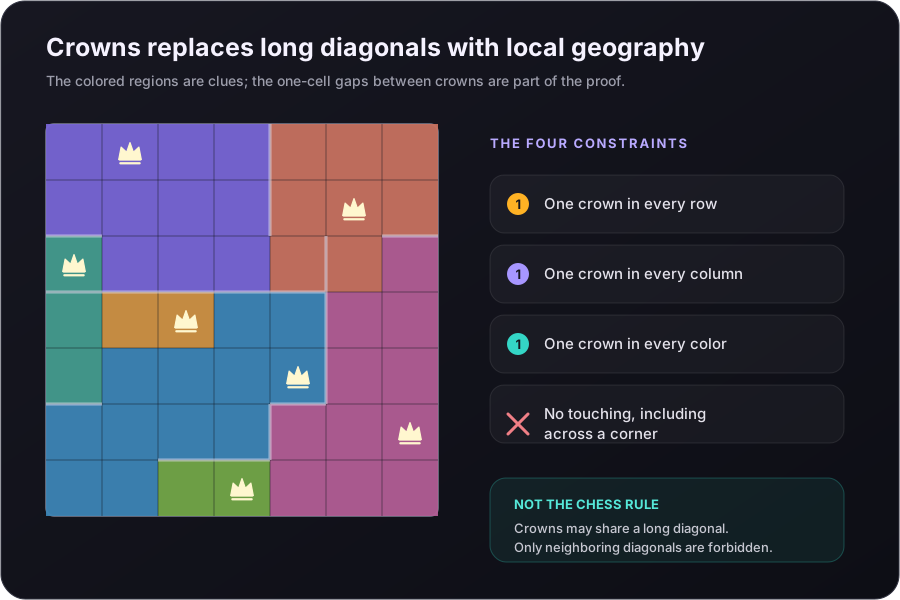
The distinction changes the solving experience. The classical problem gives an empty, uniform board and asks the solver to construct any valid arrangement. A Crowns puzzle gives a specifically partitioned board designed to have one intended solution. Instead of searching the same mathematical space every day, the player reads a new geography of regions.
The board is a network of constraints
Every crown belongs to three groups at once: a row, a column, and a colored region. Its neighboring cells add a fourth, local restriction.
That overlap is what makes deduction possible. Suppose a region can occupy cells in only two rows. Those rows now carry information about where crowns in other regions can go. If all but one cell in a row are eliminated, that remaining cell fixes a column and a region as well. One placement propagates through the board.
The original Eight Queens problem has the same underlying character. A queen is not important because it occupies one square; it is important because of the pattern of squares it forbids. Modern constraint-solving language gives a name to what nineteenth-century solvers could already see: each choice narrows several linked sets of possibilities.
How to solve Crowns without guessing
The most reliable strategy is elimination rather than trial and error:
- Mark impossible cells around every crown. A placed crown immediately clears its row, column, region, and eight-cell neighborhood.
- Look for a region trapped in one row or column. Even before its exact cell is known, that region can eliminate cells elsewhere along the shared line.
- Count remaining candidates. A row, column, or region with one available cell is forced.
- Use pairs. If two regions are confined to the same two rows, no other region can place a crown in those rows.
- Re-scan after every placement. A conclusion in one part of the board often creates a singleton somewhere distant.
The key is to record negative information. An empty square tells you little; a deliberately eliminated square is part of the proof.
Why the royal placement puzzle endures
Eight Queens survived because a single sentence creates a deep search. Crowns works for a related reason: four compact rules create an interlocking system in which progress is visible.
The two puzzles also reward different moods. The 1848 problem invites construction and enumeration: find an arrangement, then ask how many exist. Crowns invites deduction: read the regions, force one choice, and recover the board’s intended pattern.
Between them lies a broad history of recreational mathematics and computing. A challenge printed for chess enthusiasts became a model for symmetry, permutations, recursion, backtracking, and constraint satisfaction. The board changed. The queen became a crown. The central pleasure did not: one small placement reshapes every choice that remains.
Sources and further reading
- Peter M. van Hintum: The n-queens problem (University of Oxford, 2022)
- Edsger W. Dijkstra Archive: The problem of eight queens (EWD 316, 1971)
- Vasek Chvatal: All solutions to the problem of eight queens
- Wolfram MathWorld: Queens Problem
- German Chess Federation: Max Bezzel and the Eight Queens problem