From Zero and One to Sun and Moon: The Binary History Behind Equinox
A sun and a moon do not look like numbers. That is part of their charm. Beneath the warm yellow and cool violet symbols in Puzzle Round Equinox, however, lies one of the most consequential ideas in the history of mathematics: a world described with only two states.
The path from binary arithmetic to a daily logic grid is not a direct chain of invention. Gottfried Wilhelm Leibniz did not design a puzzle app, and Equinox is not an exercise in computer engineering. But they share the same startling premise: two marks, arranged carefully, can express far more than two ideas.
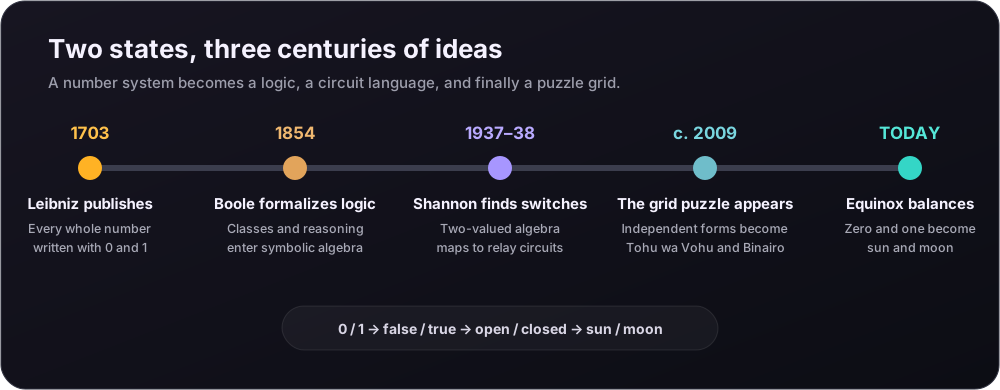
Two symbols, long before the computer
Binary notation is often introduced as the language of machines, but the modern computer arrived very late in its story.
Leibniz began working seriously on base-two arithmetic by 1679. Instead of the ten digits used in ordinary decimal notation, his system used only 0 and 1. Place value did the rest. Reading from right to left, the columns represented powers of two: 1, 2, 4, 8, 16, and so on.
The decimal number 13, for example, becomes 1101 because 13 is 8 + 4 + 1. Nothing about the number has changed. Only the alphabet used to write it has.
In 1703, Leibniz published Explication de l’Arithmétique Binaire in the journal of the French Royal Academy of Sciences. Its full title advertised both the method and its philosophical reach: binary arithmetic using the characters 0 and 1, with remarks on its usefulness and on ancient Chinese figures associated with Fu Xi.
What Leibniz saw in the I Ching
The I Ching, or Book of Changes, includes figures built from two kinds of line: solid and broken. Six stacked lines form a hexagram, and two choices across six positions create 64 possible figures.
Leibniz learned of a particular arrangement of those hexagrams through his correspondence with Joachim Bouvet, a French Jesuit working in China. He saw a striking correspondence between the two line types and his own 0-and-1 notation.
The chronology matters. Leibniz had developed binary arithmetic before receiving Bouvet’s hexagram diagram. He did not derive his number system from the I Ching, nor did the ancient text function as arithmetic in the modern computational sense. He interpreted the visual parallel as evidence that a two-symbol system could reveal a deep universal order.
That interpretation mixed mathematics, philosophy, theology, and the imperfect European understanding of Chinese thought available to him. The comparison should not be flattened into the claim that the I Ching was secretly a computer manual. What survives is the genuinely beautiful structural observation: six positions with two possible states produce 2 × 2 × 2 × 2 × 2 × 2 = 64 patterns.
Sixty-four possibilities become fourteen
An empty six-cell Equinox row has exactly the same raw count: every cell can be sun or moon, so there are 2^6 = 64 possible rows.
Then the puzzle begins cutting.
Requiring exactly three suns and three moons reduces the 64 patterns to 20. Forbidding three identical symbols in a row removes six more. Before the columns or starting clues are considered, only 14 valid row patterns survive.
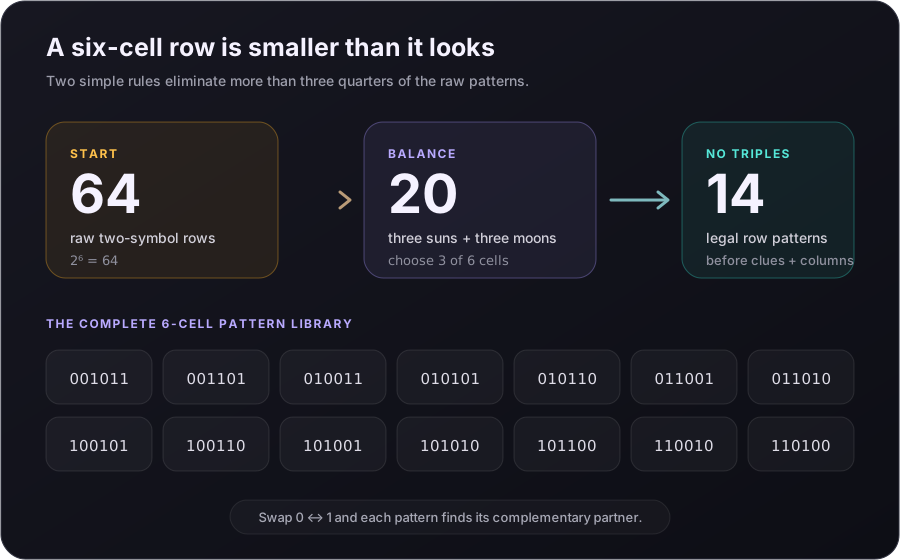
This is the hidden engine of the puzzle. The board looks spacious, but its legal pattern space is narrow. Every fixed cell removes some of those 14 candidates. Every conclusion in a crossing column removes more. Solving is the process of watching possibilities collapse until one remains.
Boole gives logic an algebra
Binary arithmetic concerns numbers, but two states can also represent propositions: yes or no, included or excluded, true or false.
George Boole made logic algebraic in The Mathematical Analysis of Logic in 1847 and developed the project further in An Investigation of the Laws of Thought in 1854. In Boole’s system, 1 represented the universe under discussion and 0 represented the empty class. Logical relationships could be manipulated with symbols and equations rather than expressed only in sentences.
Boole’s original algebra was not identical to the modern Boolean algebra taught in computer science courses; later mathematicians refined it. His decisive move was to show that reasoning itself could be formalized mathematically.
For decades, that was primarily an abstract achievement. Then a young engineer found a physical interpretation.
Shannon turns algebra into switches
In 1937, Claude Shannon completed a master’s thesis at MIT on relay and switching circuits. Automatic telephone exchanges and industrial control systems used networks of electrical relays: switches that could be open or closed.
Shannon recognized that these two physical states could be analyzed with two-valued algebra. A closed circuit and an open circuit could stand in for the same kind of alternatives handled by logical symbols. His resulting paper, A Symbolic Analysis of Relay and Switching Circuits, was published in 1938.
The achievement was not merely to label switches 0 and 1. Shannon showed how algebra could simplify circuits, determine whether two networks behaved identically, and help construct a circuit for a desired logical function. An abstract mathematics of alternatives became a practical design language for digital machinery.
Equinox does not ask you to build a relay network. Yet a move on its grid has a similar logical character. A cell has two final states. A rule accepts some combinations and rejects others. The solution emerges from propagating those restrictions through the network.
The binary puzzle appears twice
The modern binary-grid puzzle is remarkably recent. Historical accounts describe two similar forms appearing independently around the end of the 2000s.
Italian puzzle creator Adolfo Zanellati developed a puzzle called Tohu wa Vohu, using two colors with equal counts and no runs of three. Around the same time, Belgian media company PeterFrank introduced Binairo, first publishing puzzles through its BrainSnack platform. Puzzle publishers later used many names for the family: Takuzu, Binero, Binary Puzzle, Tic-Tac-Logic, Binoxxo, and Unruly among them.
Conceptis documents the parallel invention, while Simon Tatham’s puzzle collection credits Zanellati’s Tohu wa Vohu and presents the form as a black-and-white grid.
Most versions share three rules:
- equal numbers of the two symbols in each row and column,
- no three matching symbols consecutively,
- and no two completed rows or columns may be identical.
Not every variant uses all three. That distinction matters for Equinox.
How Equinox reshapes the family
Equinox uses a 6 by 6 board and keeps the two most immediately visual rules:
- every row and column contains exactly three suns and three moons;
- no row or column contains three identical symbols consecutively.
Unlike many Takuzu or Binairo versions, Equinox does not add a separate rule forbidding duplicate completed rows or columns. Its starting clues and the two displayed rules are selected so that the whole board still has exactly one completion.
The symbols change the mood as well. Zero and one suggest calculation. Black and white suggest coloring. Sun and moon suggest alternation, balance, and a sky moving through time. The logic is binary, but the presentation makes the opposition feel complementary rather than mechanical.
Three deductions do most of the work
The best Equinox moves come from recognizing small forced patterns.
The sandwich
If two matching symbols have one empty cell between them, the middle cell must be the opposite symbol. Sun-empty-sun must become sun-moon-sun; otherwise the three would match.
The pair
If two matching symbols sit together, the cells immediately before and after that pair must be the opposite symbol whenever those cells exist. A third sun cannot extend a sun-sun pair.
The balance
Once a row or column already contains three suns, every remaining empty cell in that line must be a moon. The reverse is equally true.
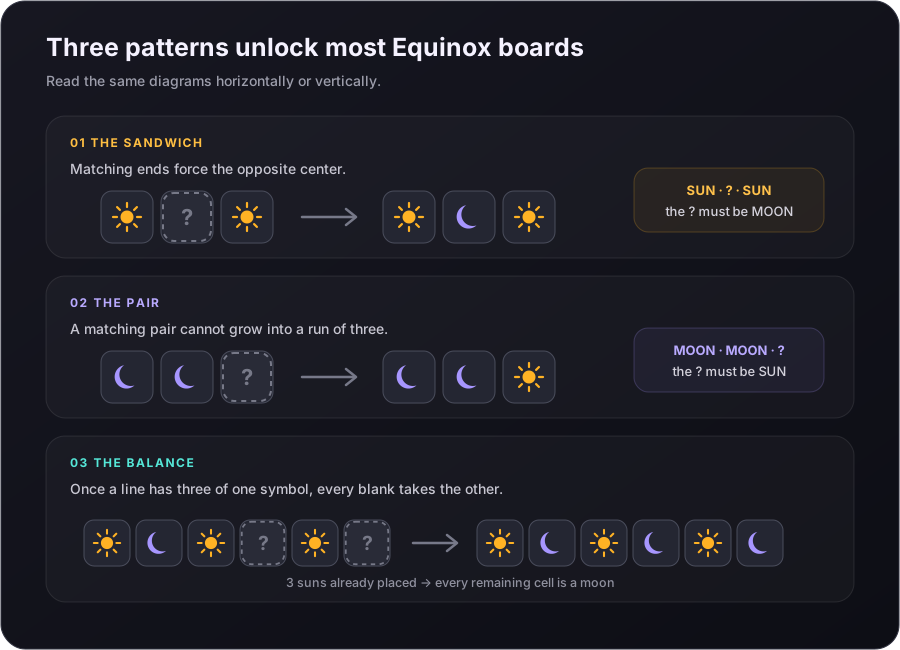
These techniques interact. A balance move can create a pair; the pair can force a cell in a crossing column; that cell can complete a sandwich elsewhere. The satisfying chain reaction is not accidental. Each local deduction reduces the global pattern space.
Why two is enough
A puzzle with only two symbols might sound impoverished. It is the opposite.
With one symbol, there is no choice. With two, opposition appears: on and off, present and absent, sun and moon. Add position and the possibilities multiply exponentially. Six cells create 64 strings. Thirty-six cells create more than 68 billion raw assignments before the rules begin their work.
The history behind Equinox repeatedly turns on this same surprise. Leibniz showed that every whole number could be written with two digits. Boole showed that logical classes could be handled algebraically. Shannon showed that networks of two-state switches could embody logical operations. Modern puzzle designers showed that two marks on a grid could sustain an elegant daily challenge.
The achievement of Equinox is to hide that enormous machinery behind an inviting sky. You do not need to think in binary, study algebra, or wire a relay. You only need to notice that two suns cannot become three - and let one small certainty illuminate the next.
Sources and further reading
- Gottfried Wilhelm Leibniz: Explanation of Binary Arithmetic (1703, English translation)
- Mathematical Association of America: Leibniz, binary numbers, and the I Ching
- Stanford Encyclopedia of Philosophy: George Boole
- Claude E. Shannon: A Symbolic Analysis of Relay and Switching Circuits (1938)
- Conceptis: Tic-Tac-Logic history
- Simon Tatham’s Portable Puzzle Collection: Unruly